A CNC machining quote can sometimes come as a surprise. A part may look fairly simple on a drawing, yet the price is much higher than expected. This usually happens because the visible shape tells only part of the story. The time needed to hold the workpiece, reach difficult features, control dimensions, and inspect the finished part can have a real effect on cost.
For buyers sourcing custom metal components, understanding these details makes it easier to review a quotation and discuss practical changes with a supplier. In many cases, the goal is not to find a cheaper machine shop. It is to find out which parts of the design are making production more difficult than necessary.
Material prices are an obvious starting point, but the amount of material purchased is not always close to the amount left in the finished component.
Imagine a small aluminum block that needs to be machined into a bracket with several pockets. The final part may weigh much less than the original blank. The supplier still has to purchase the larger piece of stock, and the machine must remove the unwanted material. Both factors affect the final price.
Material choice also changes machining time. Aluminum is generally easier to cut than many stainless steel grades, while some harder or tougher alloys require slower cutting conditions and more careful tool selection. Tool wear, heat, and chip removal can all influence production efficiency.
If the application allows more than one material, ask the manufacturer whether an alternative grade would meet the same requirements at a lower total cost. A substitution should always be checked against strength, corrosion resistance, operating temperature, and the relevant material standard.
A component does not need to be large to be expensive. A narrow slot, deep pocket, or small internal corner may require special tools and additional machining passes.
Deep holes are a good example. As the hole becomes deeper relative to its diameter, removing chips and controlling tool deflection can become more difficult. The machinist may need to adjust cutting parameters or use specialized tooling to achieve the required result.
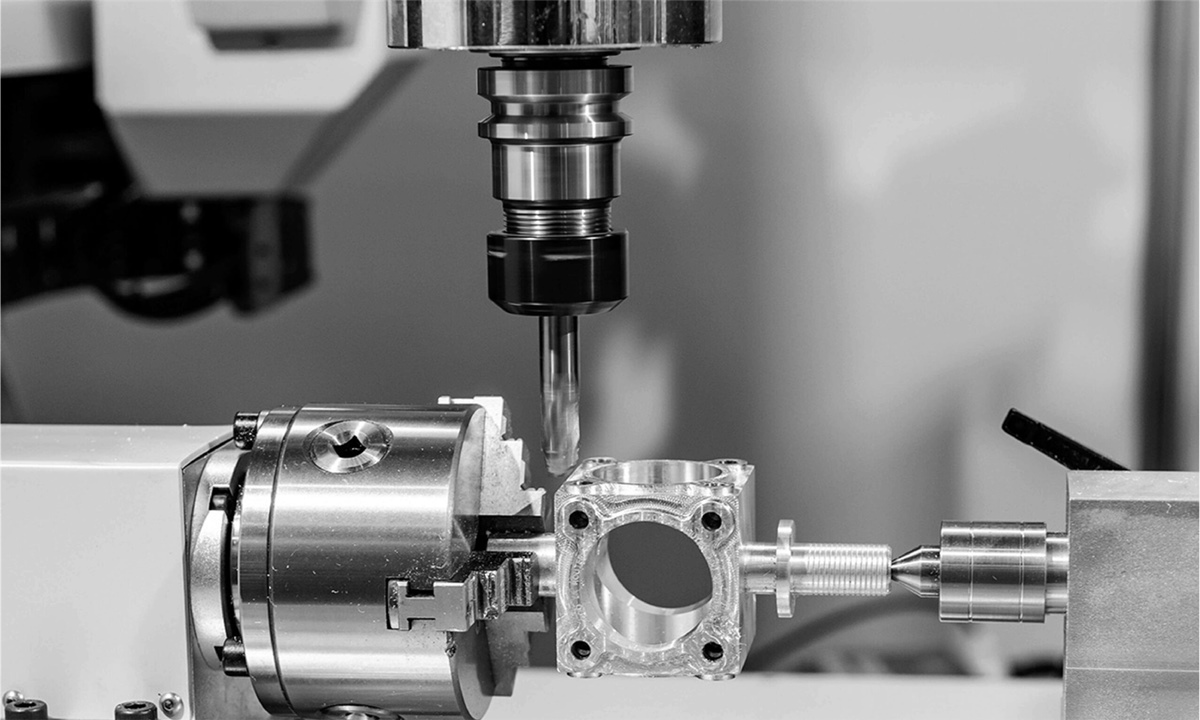
Internal corners can cause a similar problem. If a design specifies a very small corner radius, a small-diameter cutter may be needed. Smaller tools can require slower machining and may be more vulnerable to breakage.
This does not mean that every feature should be enlarged. The design must still perform its intended function. However, when a tiny radius or unusually deep feature has no clear engineering purpose, reviewing it before production may save time and money.
One detail that can increase a CNC machining quote is the tolerance specification. A supplier may be able to produce a dimension within a broad tolerance relatively quickly, but holding a much tighter range can require additional setup checks, measurements, and process adjustments.
Consider a mounting bracket with ten holes. Perhaps two holes locate the part in an assembly, while the other eight are only used for clearance. If all ten holes have unnecessarily tight tolerances, the drawing may demand more precision than the application needs.
The better approach is to identify which dimensions actually affect fit, movement, sealing, or load transfer. Give those features the appropriate tolerances and avoid applying the same restrictive requirements to every surface.
Tolerances should not be relaxed simply to reduce price. They need to match the design requirements and relevant standards. A brief drawing review with the supplier can help identify where precision is essential and where a more practical specification may be acceptable.
Some components can be machined in one setup. Others need to be turned, clamped again, and aligned several times before all features are complete.
Every additional setup takes time. The operator must secure the workpiece, establish its position, and confirm that the next operation lines up with the previous ones. More setups can also introduce additional opportunities for alignment errors.
This is one reason two parts with similar dimensions may receive different quotations. One design might allow most features to be reached from a single direction, while the other requires several operations to reach its sides and underside.
During design review, ask whether important features can be arranged to improve tool access or reduce repositioning. For repeat orders, suitable fixtures may also help improve consistency and reduce preparation time.
Machining parts may also require deburring, polishing, anodizing, electroplating, passivation or other protective treatment prior to shipment. These operations increase costs, and the final price depends on the specified degree of completion and the geometry of the part.
For example, parts with threaded holes or carefully controlled mating surfaces may require masking or additional inspection after coating. Complex shapes also make it more difficult to obtain consistent finishing results.
Buyers should specify the required processing, rather than using general descriptions such as ' corrosion resistance '. Different finishes provide different properties, and the right choice depends on the material and operating environment.
Whether the quotation includes collation is also worth confirming. Lower processing costs may not represent the full cost of a completed, inspected part.
Whether an order consists of ten or several hundred pieces, programming, fixture preparation, tool selection and initial inspection take time. For small batches, these preparation costs are dispersed among fewer parts.
It is assumed that the supplier needs to prepare processing procedures and fixtures before starting production. Increasing the order quantity can reduce the preparation cost allocated to each part, although the material and processing costs will still increase with the increase of the total amount.
Larger orders are not automatically cheaper in each case. Complex parts may require a lot of processing, and material prices or finishing requirements can change the economy. Still, it is useful to tell the supplier about expected repeat orders when requesting a quotation.
If demand is uncertain, ask for prices at two or three realistic quantities. This gives you a clearer picture of how the unit cost changes with production volume.
A supplier can usually prepare a more reliable quote when the request includes a complete engineering drawing, a 3D model if available, material grade, quantity, tolerance requirements, surface finish, and delivery expectations.
It helps to identify critical dimensions and explain the part's application. If the design has deep cavities, thin walls, or other challenging features, ask whether a manufacturing review could identify a simpler production route.
When comparing quotations, check that each supplier is pricing the same specification. Confirm whether the price includes finishing, inspection reports, packaging, and other secondary operations. Otherwise, the cheapest figure may not be the cheapest complete solution.
A higher CNC machining quote does not always mean that a supplier is charging too much. Sometimes it reflects a demanding drawing or a difficult production route. Understanding the reason behind the price is the first step toward deciding whether a design change, different material, or adjusted order quantity could deliver better value.
-